When I first flew into Hanoi, I was excited.
Not cautious. Not skeptical. Excited.
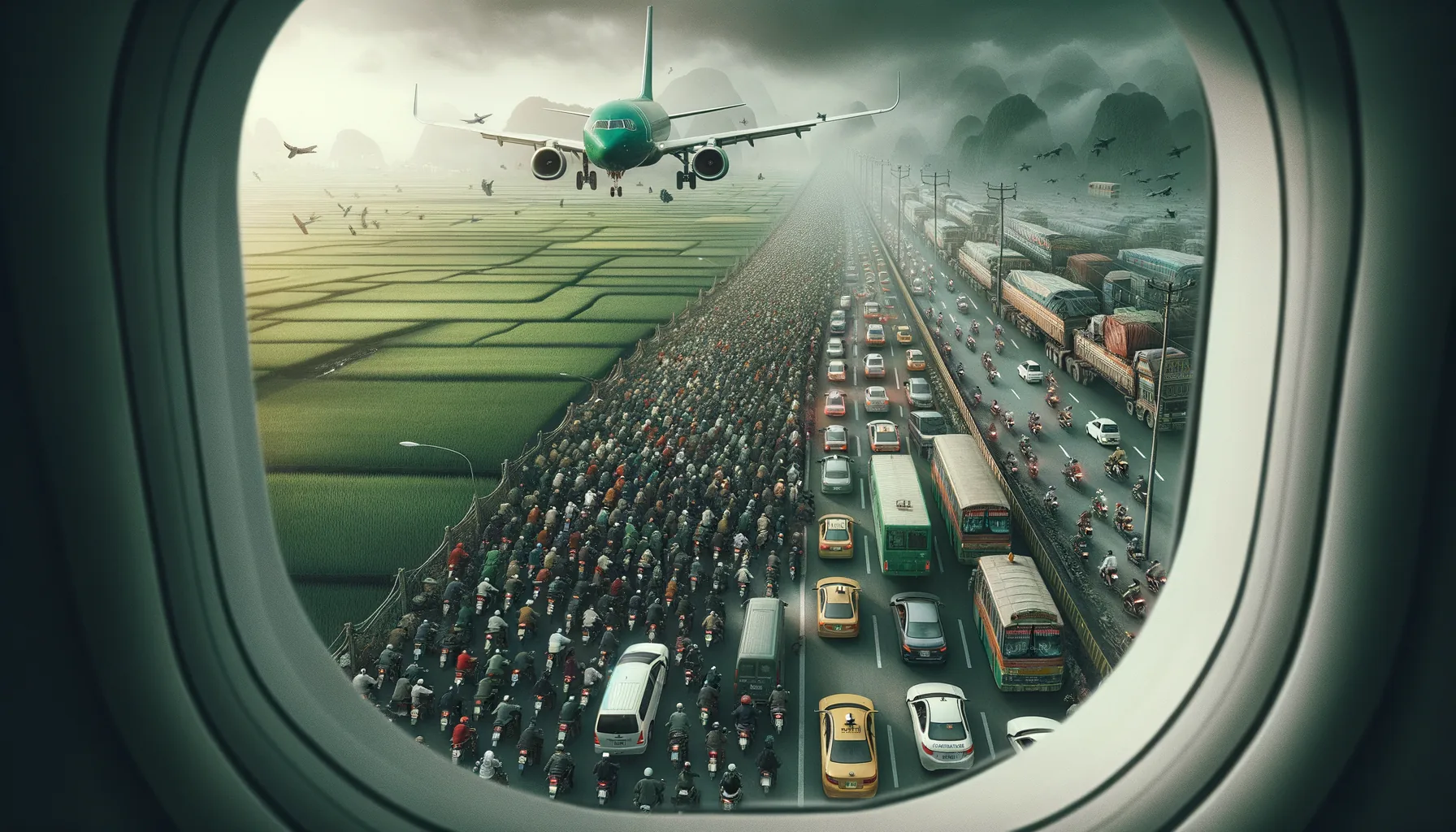
From the sky, everything looked peaceful. Fields, narrow roads, little clusters of buildings, water reflecting light in the distance. It had that kind of softness some places only have from above, where reality still had not had the chance to introduce itself properly.
Even the airport felt manageable. Not some giant soulless machine. Smaller. More human. I remember thinking, alright, this is nice. Maybe this will be easier than people say.
Then I hit immigration.
That was my first lesson.
The queue was long enough to make you question whether the concept of time had already been confiscated with your passport. Everyone stood there in that half-zombie travel state, quietly aging under fluorescent light while the line moved with all the urgency of a retired turtle doing admin.
And this is one of Vietnam’s secret talents. It can look completely normal while wasting your life in ways so casual they almost feel artistic.
Still, I got through. Passport stamped. Officially in.
Then I walked out of the airport.
That was the second lesson.
Suddenly it was:
Taxi sir.
Sir taxi.
Where you go.
Taxi taxi taxi.
Not aggressive enough to be a crime. Not subtle enough to be dignity. Just a chorus of logistical opportunism waiting outside the sliding doors.
I had booked Klook. In theory, this meant I had already solved the transport problem. In practice, it meant I had simply upgraded to a more structured version of confusion.
Because of course nobody spoke English.
Or rather, enough English to create hope, but not enough to create clarity.
That is another Vietnam specialty. It often gives you just enough confidence to walk into the misunderstanding yourself.
If not for Google Translate, I would have died. Maybe not physically. But administratively, spiritually, conversationally, definitely.
Google Translate in Vietnam is not a convenience. It is life support.
Eventually I found the driver, or maybe he found me, or maybe fate got bored and pushed the situation forward. We got in the car and started driving.
Then came the highway.
And the horns.
This was the third lesson.
The road was packed. Movement happened, but only in theory. Everything crawled forward in a kind of reluctant mass negotiation. Cars, buses, bikes, intentions, all pressing into the same space with the same basic philosophy: I move, you deal with it.
And the horns. My God, the horns.
Not one horn. Not occasional horn. Not “please be careful” horn.
A full orchestral performance of public impatience.
In many countries, the horn means anger. In Vietnam, the horn means existence. It means: I am here. I am coming through. Do not be surprised by my decision. Also maybe good luck.
What amazed me was that despite how chaotic it sounded, it somehow still functioned. Not well. Not elegantly. Not in a way any civil engineer would frame on a wall. But it moved.
Slowly. Loudly. Questionably. But it moved.
And somewhere on that first drive, between the jam, the noise, the strange rhythm of half-order and half-chaos, I started to understand something.
Vietnam was not going to be hard in the obvious ways.
It was going to be hard in the layered ways. The way where things technically work, but never quite the way you expect. The way where systems exist, but the human improvisation around them is still doing most of the heavy lifting. The way where your real problem is not danger. It is interpretation.
That was the first lesson.
Not that Vietnam was broken. Not that Vietnam was bad. Just that from the moment you land, the country starts teaching you one thing very clearly:
If you want to survive here, understanding the system matters a lot more than assuming there is one.