
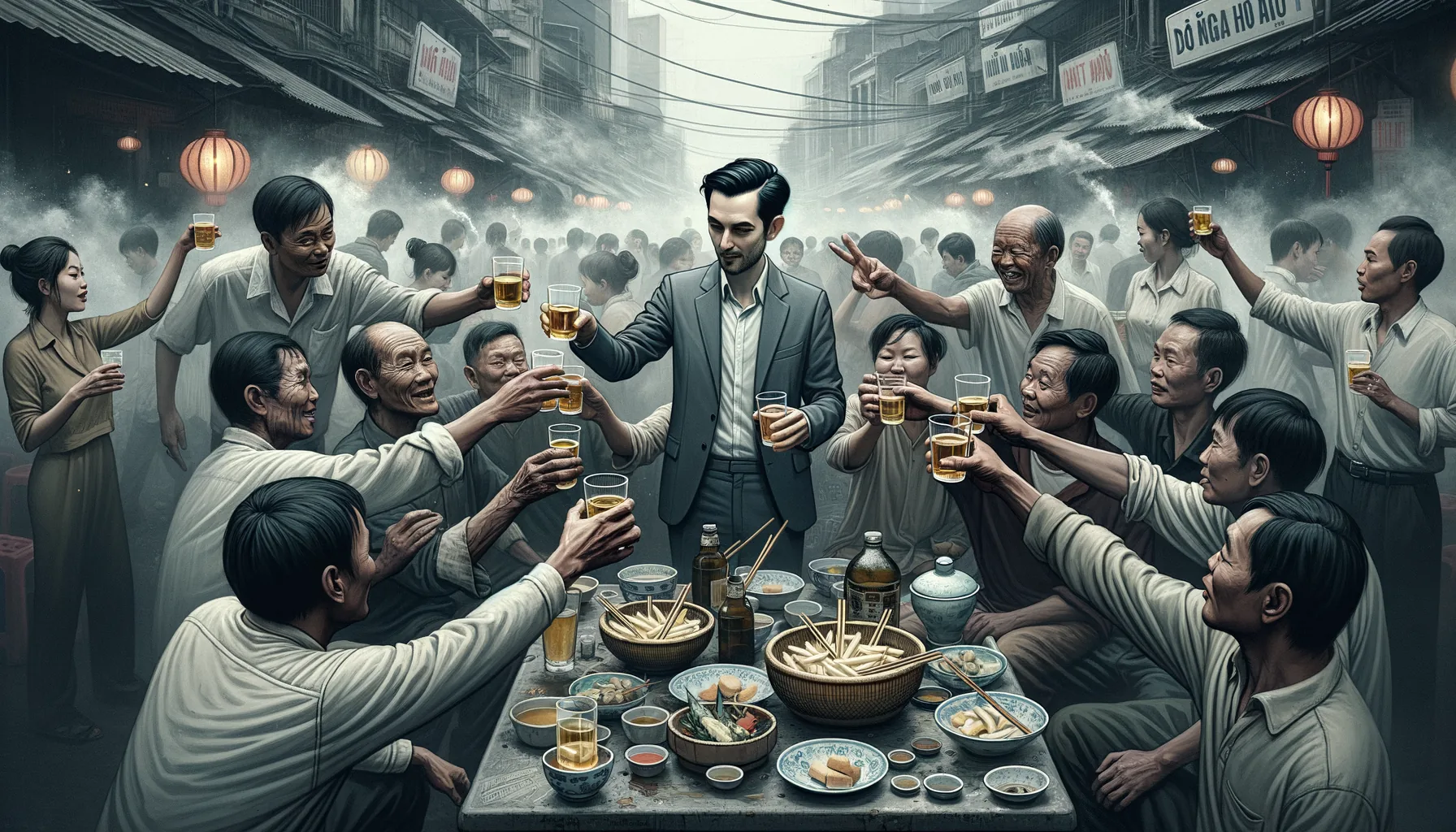
One thing Vietnam understands at a very high level is social acceleration.
Not the traffic.
That is a separate humanitarian issue.
I mean people.
In some countries, friendship takes time.
You build trust carefully.
You exchange polite information.
You warm up in stages.
In Vietnam, someone can look at you, pour alcohol into a tiny glass, shout một, hai, ba, and suddenly you are no longer a guest.
You are now participating.
This is one of the country's best qualities.
Warmth moves fast.
Not always wisely.
Not always quietly.
But fast.
A meal becomes a gathering.
A gathering becomes a round.
A round becomes another round because apparently saying no too early would disrespect at least three generations of hospitality.
Before long, someone is laughing, someone is smoking, someone is putting food on your plate without permission, and someone else has decided you need to hear a story that requires both shouting and arm contact.
And honestly, it is hard not to enjoy.
Vietnam can be bureaucratically cold and socially warm in a way that makes no logical sense and yet somehow works emotionally.
The same country that can send you to three offices for one stamp can make you feel more included at dinner than places with flawless public transport and emotional central heating.
The drinking culture is part hospitality, part bonding ritual, part pressure tactic, part national liver stress test.
Ten percent friendship.
Ninety percent organ negotiation.
Still, there is something deeply alive about it.
The energy.
The ease.
The speed at which distance collapses.
Nobody asks whether this is efficient.
Nobody asks whether you have an early morning.
Nobody asks whether your internal organs had other plans.
They ask if your glass is empty.
Which, culturally, is apparently the only important metric.
Of course, there is a darker side.
Too much drinking.
Too much masculine chaos.
Too much emotional volume disguised as bonding.
Sometimes warmth and pressure arrive holding hands.
But when it works, it really works.
You feel welcomed in a way many polished countries no longer know how to do.
That matters.
Because systems make a place functional.
People make it worth remembering.