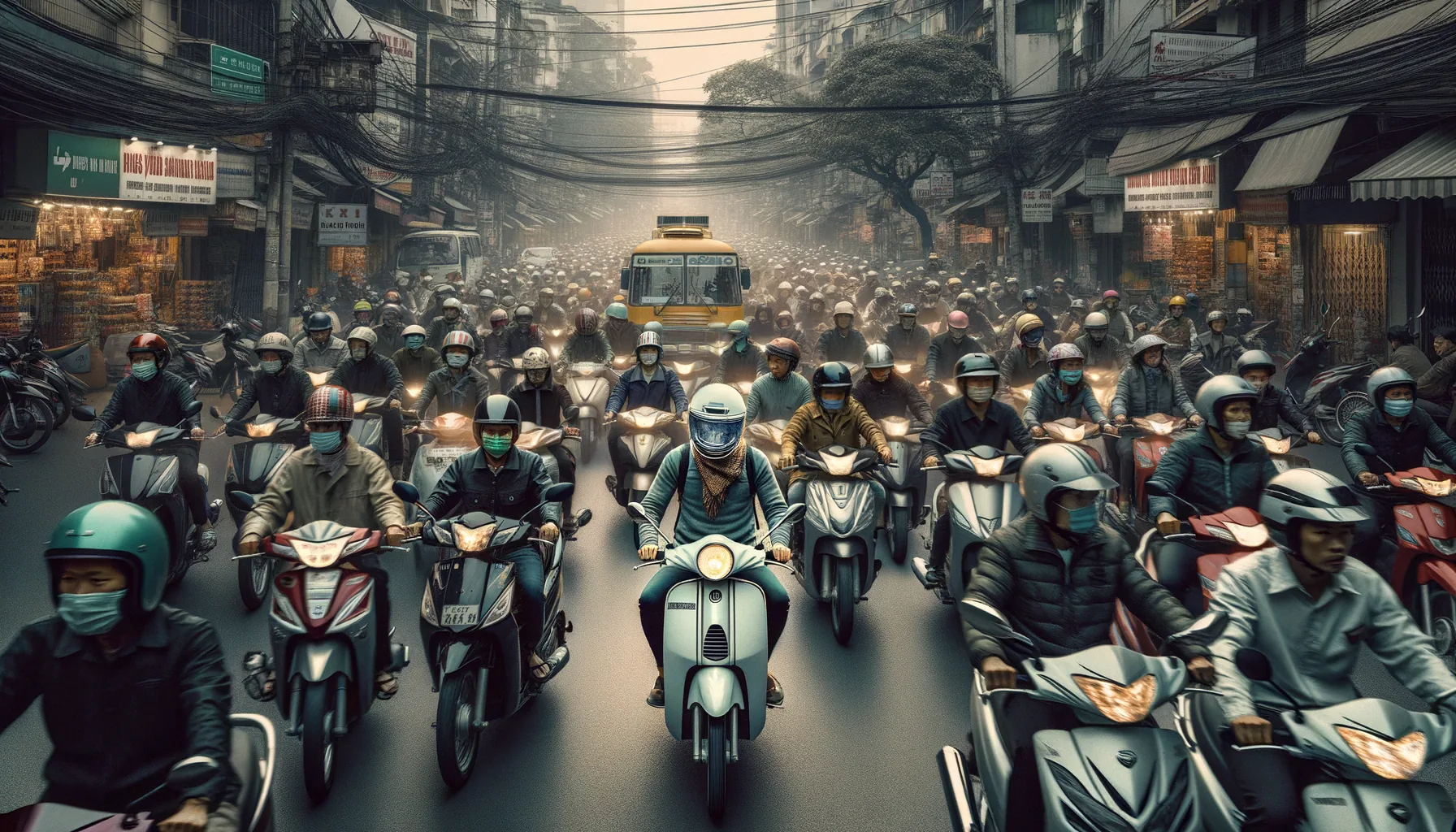
The first time you really look at traffic in Hanoi, you assume one of two things.
Either:
this is madness.
Or:
surely there are accidents every ten seconds.
Then somehow, neither is fully true.
That is what makes it fascinating.
Traffic here is not rule based in the way many foreigners understand rules.
It is flow based.
Instinct based.
Micro negotiation based.
Possibly reincarnation queue based.
People move before the light fully changes.
People turn where there is technically no invitation.
People squeeze through gaps that in other countries would qualify as attempted murder with body language.
And the horn is not just a horn.
The horn is language.
It means:
I am here.
I am coming through.
Please do not suddenly become philosophical.
Good luck to all of us.
To foreigners, this looks suicidal.
To locals, it looks like Tuesday.
What amazed me most was not the chaos.
It was the adaptation.
People grow up inside this rhythm.
They learn how to read movement, hesitation, body angle, wheel angle, speed intention.
The whole thing looks like a mess until you realize there is actually a hidden grammar.
Not a clean grammar.
Not a civilized grammar.
But a grammar.
And then you leave Vietnam.
You get into a car in a more structured country.
The lanes make sense.
The speed is smooth.
The road is quiet.
No one is horn morse coding their entire emotional history into the intersection.
And suddenly someone who has adapted to Vietnam says the cars feel bad.
Too fast.
Too smooth.
Too strange.
But the cars are not the problem.
The body has adapted to disorder.
That is what poor planning does over time.
It rewrites normal.
You stop noticing the stop go rhythm.
You stop noticing the fumes.
You stop noticing the horns.
You stop noticing that every intersection feels like social Darwinism with indicators.
Until you leave.
Then it hits you.
This is not just traffic.
It is a whole civic philosophy:
everybody move,
nobody wait too long,
and may the sharpest reflexes beat reincarnation's cutoff time.